
Step-by-Step Solution
Step 1
We are given the value of resultant force ${{\bf{F}}_R} = {{\bf{F}}_1} + {{\bf{F}}_2}$.
We are asked to estimate the magnitudes of the resultant force.
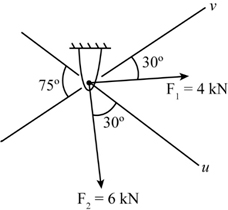
Step 2
The following is the diagram from the parallelogram law of addition.
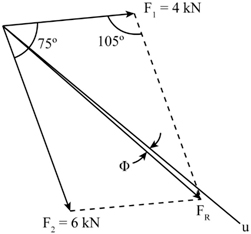
The diagram of the resultant force is as follows:
Step 3
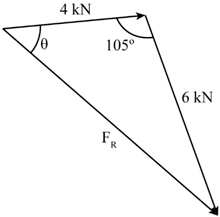
The relation from the law of cosines is,\[{{\bf{F}}_R} = \sqrt {{{\bf{F}}_1} + {{\bf{F}}_2}^2 – 2{{\bf{F}}_1}{{\bf{F}}_2}\cos \theta ‘} \]
Plugging in the known values in the above relation.\begin{array}{l} {{\bf{F}}_R} = \sqrt {{{\left( {4\;{\rm{N}}} \right)}^2} + {{\left( {6\;{\rm{N}}} \right)}^2} – 2\left( {4\;{\rm{N}}} \right)\left( {6\;{\rm{N}}} \right)\cos \left( {105^\circ } \right)} \\ {{\bf{F}}_R} = \sqrt {52 + 12.42} \;{\rm{N}}\\ {{\bf{F}}_R} = 8.026\;{\rm{N}} \end{array}
To find the magnitude of force we will use the law of sines.\[\frac{{\sin \theta }}{{{{\bf{F}}_2}}} = \frac{{\sin 105^\circ }}{{{{\bf{F}}_R}}}\]
Plugging the known values in the above relation.\begin{array}{c} \frac{{\sin \theta }}{{6\;{\rm{N}}}} = \frac{{\sin 105^\circ }}{{8.026\;{\rm{N}}}}\\ \theta = 46.22^\circ \end{array}
Step 4
To find the direction of the resultant force we will use the following relation.\[\phi = \theta – {\theta _R}\]
Plugging the known values in the above relation.\begin{array}{l} \phi = \left( {46.22^\circ } \right) – \left( {45^\circ } \right)\\ \phi = 1.22^\circ \end{array}