
Ali Raza

Determine the magnitude of the resultant forceFR = F1 + F2 and its direction, measured clockwise fromthe positive u axis.

Step-by-Step Solution Step 1 We are given the value of resultant force ${{\bf{F}}_R} = {{\bf{F}}_1} + {{\bf{F}}_2}$. We are asked to estimate the magnitudes of the resultant force. Step 2 The following is the diagram from the parallelogram law of addition. The diagram of the resultant force is as follows: Step 3 The relation from […]
Determine the magnitude of the resultant forceFR = F1 + F2 and its direction, measured clockwise fromthe positive u axis. Read More »

Solve Prob. 2–4 with F = 350 lb.

Step-by-Step Solution Step 1 We are given the value of force $F = 3{\rm{50 lb}}$. We are asked to estimate the magnitudes of the two components of F. Step 2 The relation to convert the force from pound into newton is, Since $1\;{\rm{lb}} = {\rm{4}}{\rm{.448}}\;{\rm{N}}$, then\begin{array}{c} 3{\rm{50 lb}} = \left( {350\;{\rm{lb}} \times \frac{{{\rm{4}}{\rm{.448}}\;{\rm{N}}}}{{1\;{\rm{lb}}}}} \right)\\ =

Solve Prob. 2–4 with F = 350 lb. Read More »

The vertical force F acts downward at A on the twomembered frame. Determine the magnitudes of the twocomponents of F directed along the axes of AB and AC.Set F = 500 N.

Step-by-Step Solution Step 1 We are given the value of force $F = {\rm{500 N}}$. We are asked to estimate the magnitudes of the two components of F. Step 2 The following is the free body diagram to calculate the magnitude of force related to link AB. To find the magnitude of force we will

The vertical force F acts downward at A on the twomembered frame. Determine the magnitudes of the twocomponents of F directed along the axes of AB and AC.Set F = 500 N. Read More »

Determine the magnitude of the resultant forceFR = F1 + F2 and its direction, measured counterclockwisefrom the positive x axis.

Step-by-Step Solution Step 1 We are given the force ${F_R} = {F_1} + {F_2}$,${F_1} = 250\;{\rm{lb}}$ and ${F_2} = 375\;{\rm{lb}}$. We are asked to determine the magnitude and direction of the resultant force. Step 2 The following is the diagram to calculate the projected component of the force. To find the magnitude of the resultant

Determine the magnitude of the resultant forceFR = F1 + F2 and its direction, measured counterclockwisefrom the positive x axis. Read More »

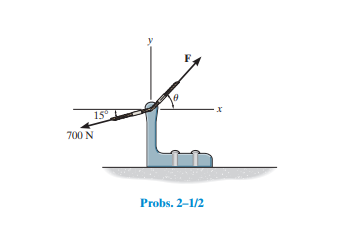
If the magnitude of the resultant force is to be 500 N,directed along the positive y axis, determine the magnitudeof force F and its direction u.

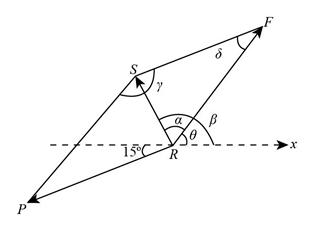
Step-by-Step Solution Step 1 We are given the force ${F_R} = 500\;{\rm{N}}$ and ${F_1} = 700\;{\rm{N}}$. We are asked to determine the magnitude of force ${\bf{F}}$ and its direction ${\bf{\theta }}$. Step 2 The following is the diagram of the vector component. The following is the diagram of the vector component tail to tail. Step

If the magnitude of the resultant force is to be 500 N,directed along the positive y axis, determine the magnitudeof force F and its direction u. Read More »

2–1. If u = 60 and F = 450 N, determine the magnitudeof the resultant force and its direction, measuredcounterclockwise from the positive x axis.

Step-by-Step Solution Step 1 Given that the angle $\theta $ is $60^\circ $, and the force $F = 450\;{\rm{N}}$. We are required to determine the resultant force and its direction measured counter clockwise from the positive $x$ -axis. Step 2 We have to make the parallel lines from the force vectors to get a parallelogram.

2–1. If u = 60 and F = 450 N, determine the magnitudeof the resultant force and its direction, measuredcounterclockwise from the positive x axis. Read More »

Two particles have a mass of 8 kg and 12 kg,respectively. If they are 800 mm apart, determine the forceof gravity acting between them. Compare this result withthe weight of each particle.

Step-by-Step Solution Step 1 Given that the mass of first particle is $8\;{\rm{kg}}$ and the mass of second particle is $12\;{\rm{kg}}$. Also the spacing between the particles is $800\;{\rm{mm}}$ We are required to determine the gravitational force between particles and we need to compare the force with weights. Step 2 The length $1\;{\rm{mm}}$ is equal

Two particles have a mass of 8 kg and 12 kg,respectively. If they are 800 mm apart, determine the forceof gravity acting between them. Compare this result withthe weight of each particle. Read More »

If a man weighs 155 lb on earth, specify (a) hismass in slugs, (b) his mass in kilograms, and (c) his weight innewtons. If the man is on the moon, where the accelerationdue to gravity is gm = 5.30 ft/s2, determine (d) his weightin pounds, and (e) his mass in kilograms.1–21. Two particles have a mass of 8 kg and 12

Step-by-Step Solution Step 1 Given that the weight of the man on Earth is $155\;{\rm{lb}}$, and the acceleration due to gravity on the moon is ${g_m} = 5.30\;{\rm{ft/}}{{\rm{s}}^2}$. We are required to find out the mass of man on Earth in slugs, kilograms and man’s weight in Newton. Also it is required to find out

If a man weighs 155 lb on earth, specify (a) hismass in slugs, (b) his mass in kilograms, and (c) his weight innewtons. If the man is on the moon, where the accelerationdue to gravity is gm = 5.30 ft/s2, determine (d) his weightin pounds, and (e) his mass in kilograms.1–21. Two particles have a mass of 8 kg and 12 Read More »

A concrete column has a diameter of 350 mm anda length of 2 m. If the density (mass/volume) of concrete is

Step By Step Solution Step 1 We have the given diameter $350\;{\rm{mm}}$, length $2\;{\rm{m}}$, and the density of the concrete $2.45\;{{{\rm{Mg}}} \mathord{\left/ {\vphantom {{{\rm{Mg}}} {{{\rm{m}}^3}}}} \right. } {{{\rm{m}}^3}}}$. We are required to determine the weight of column in pounds. Step 2 Convert the unit of diameter $\left( d \right)$ into SI units.\[\begin{array}{c} d = 350\;{\rm{mm}}\\

A concrete column has a diameter of 350 mm anda length of 2 m. If the density (mass/volume) of concrete is Read More »

Evaluate each of the following to three significantfigures and express each answer in SI units using anappropriate prefix: (a) 354 mg(45 km)/(0.0356 kN),

Step-by-Step Solution Step 1 The given quantities are (a) ${{354\;{\rm{mg}}\left( {45\;{\rm{km}}} \right)} \mathord{\left/ {\vphantom {{354\;{\rm{mg}}\left( {45\;{\rm{km}}} \right)} {\left( {0.0356\;{\rm{kN}}} \right)}}} \right. } {\left( {0.0356\;{\rm{kN}}} \right)}}$, (b) $\left( {0.00453\;{\rm{Mg}}} \right)\left( {201\;{\rm{ms}}} \right)$, and (c) ${{435\;{\rm{MN}}} \mathord{\left/ {\vphantom {{435\;{\rm{MN}}} {23.2\;{\rm{mm}}}}} \right. } {23.2\;{\rm{mm}}}}$ We are asked to determine the value of given quantities in SI units in

Evaluate each of the following to three significantfigures and express each answer in SI units using anappropriate prefix: (a) 354 mg(45 km)/(0.0356 kN), Read More »